
Uninsured Motorist Coverage: How Much You Really Need
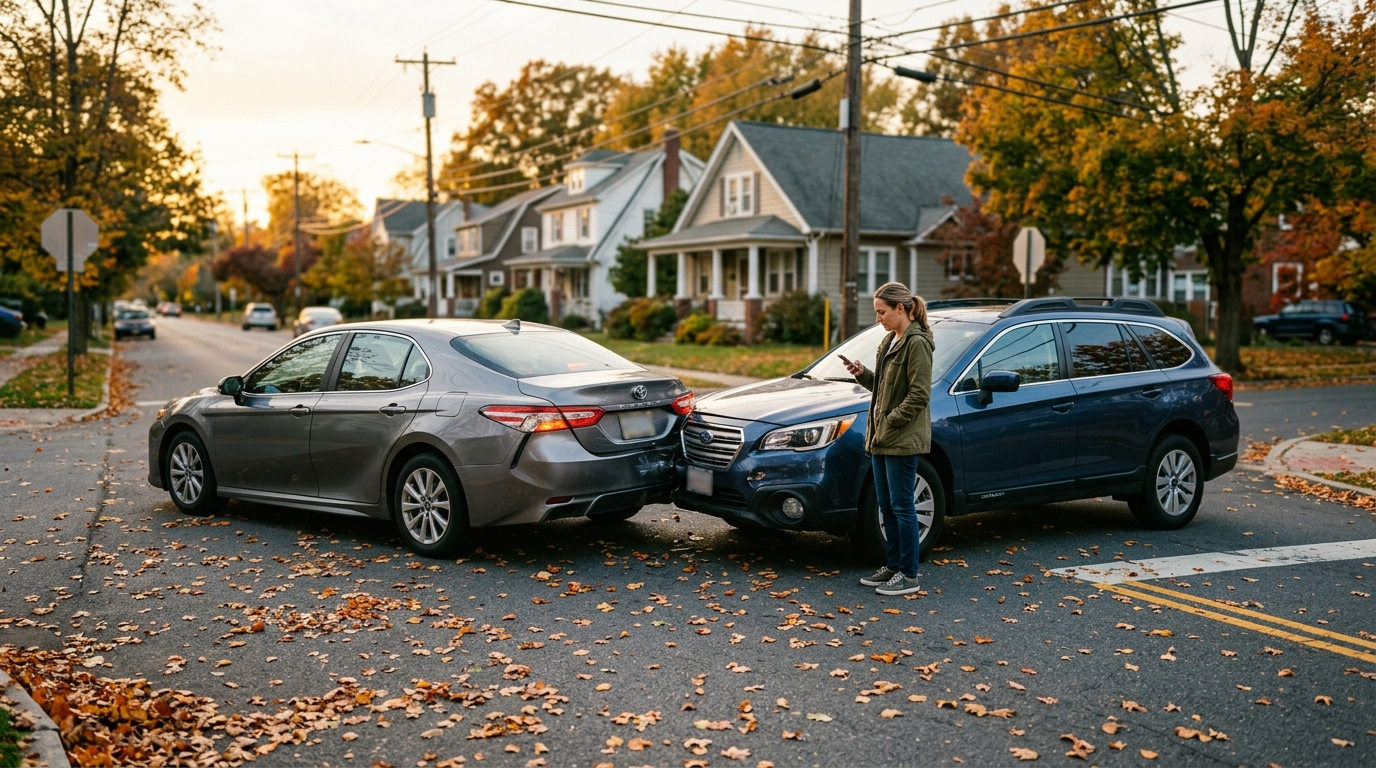
Uninsured motorist coverage is the quiet line item that carries the most weight when a crash turns ugly — and plenty of drivers either decline it or accept the state minimum without another thought. This guide lays out what UM and UIM actually pay, roughly what they cost, and how to set limits so a serious wreck with the wrong driver does not drain a savings account.
In this article
What UM and UIM Are Built to Pay
Uninsured motorist coverage (UM) takes over when the driver who hit you had no policy whatsoever. Underinsured motorist coverage (UIM) applies when that driver did have insurance, but the liability limits fall short of the damage done. Carriers almost always sell the pair together, and each comes in two forms: bodily injury (UMBI/UIMBI) and property damage (UMPD/UIMPD).
Bodily injury is the half that matters. It handles medical bills, missed wages, and pain-and-suffering damages that would ordinarily be paid by the other driver's liability policy — identical categories, just funded by your own carrier. The property damage versions handle vehicle repairs, but they duplicate collision so heavily that anyone already carrying collision usually passes on UMPD unless the price is trivial.
Law requires UM in about 20 states along with Washington, D.C. Where it stays optional — Texas, Arizona, and California among them — carriers are still obligated to offer it, and turning it down normally means signing a written waiver.
Why Drivers Keep Buying Too Little
By industry estimates, something like one in eight US drivers operates with no coverage at all, and the rate swings wildly from state to state. Mississippi, Michigan, Tennessee, and New Mexico cluster at the top end, nearer one in four by some counts. Fold in everyone who technically carries insurance but only at the state floor — frequently $25,000 or less in bodily injury per person — and the share of drivers who are effectively uninsured runs much higher than people imagine.
The arithmetic is the painful part. One overnight hospital admission after a wreck commonly bills out at $30,000 to $60,000 — and surgery drives the figure toward six digits. When the at-fault driver holds a $25,000 policy and owns nothing worth pursuing, that policy is the ceiling on any recovery — and suing a defendant with empty pockets can consume years and produce nothing.
UM/UIM sidesteps the whole problem. The claim goes to the injured driver's own company, moves on that company's schedule, and stops only at the limits that were purchased.
The Price Tag on Uninsured Motorist Coverage
On most policies this is among the least expensive items on the page. Annual costs generally look like this:
- UM/UIM at the state minimum: $30 to $75 annually
- Moderate limits of $100,000 / $300,000: $75 to $150 annually
- Strong limits of $250,000 / $500,000: $125 to $225 annually
- Stacking across multiple vehicles: about 10 to 20 percent more than the unstacked version of the same tier
What you actually pay turns on the state, the driving record, and the liability limits underneath, since carriers generally cap UM/UIM at or below the bodily injury liability already on the policy. Doubling UM/UIM costs a small fraction of what doubling BI liability costs, because the pool of risk is smaller — most drivers do carry insurance.
Ready to compare car insurance rates?
See quotes from top insurers side by side. Free, about two minutes, no obligation.
Get My Quotes →How Stacking Multiplies Your Limits
Where state law permits it, stacking lets a driver add UM limits together across several insured vehicles on one policy — and in certain states across separate household policies. A stacked claim typically unfolds like this:
- Three cars sit in the garage, each carrying $100,000 in UM per person.
- An uninsured motorist injures the owner while they are behind the wheel of one of them.
- Rather than $100,000 of available UM, $300,000 becomes reachable, since the limits on all three vehicles combine.
- Payment runs to whatever the actual damages are, with the stacked figure as the ceiling.
Florida, Pennsylvania, Kentucky, and Georgia are among the states that permit stacking, while California and New York are among those that do not. It does cost extra, but a household running several cars on moderate per-vehicle limits can more than triple its available coverage for a fairly small increase.
UM and UIM: Which One Fires First
The two coverages sound like near twins, yet they switch on under different conditions and relate to the at-fault driver's policy in different ways.
| Scenario | Coverage Triggered | Who Pays |
|---|---|---|
| The other driver carries no policy | UM bodily injury | Your UM limits |
| The other driver leaves the scene | UM (in most states) | Your UM limits |
| The other driver has $25K against $80K in damages | UIM bodily injury | $25K from their carrier, then up to $55K from your UIM |
| The other driver's limits are sufficient | Neither | Their liability policy |
Two principles run UIM in most jurisdictions. The at-fault policy goes first, and UIM then covers the shortfall up to the injured driver's own limit. Beyond that, some states apply a difference in limits approach, where UIM pays only when its limits sit above the at-fault BI limits, while others use an excess approach that lets UIM respond any time damages run past the other driver's limits. Pull out the declarations page and read it.
The Moments UM/UIM Saves Serious Money
Hit-and-run is the cleanest example. Somebody rear-ends you at a red light, takes off, and nobody caught the plate — in almost every state that fires UM exactly as though the runaway driver had no insurance. Hospital charges, ER co-pays, and missed income all convert into a UM claim, with a deductible attached in a small number of states.
Passenger injuries are the other case people forget. UM/UIM on a personal auto policy usually extends to passengers riding in the insured car, relatives struck while walking, and relatives driving other vehicles — worth confirming with the carrier, because the definition of household varies.
Financially, the ruinous version is a severe injury inflicted by someone carrying $25,000 in liability. A fractured vertebra, shoulder surgery, or a traumatic brain injury exhausts that limit before the ambulance invoice even arrives. With no UIM in place, the remainder falls on the injured driver's health plan — which will then subrogate against any settlement — and on their own balance sheet.
Setting UM/UIM Limits at the Right Level
A handful of guidelines hold up in nearly every state:
- Mirror your bodily injury liability limits. With BI at 100/300, UM/UIM belongs at 100/300 as well. Insuring strangers more generously than your own family makes no sense.
- Treat $100,000 per person as the floor. The statutory minimums — often 25/50 or 30/60 — come nowhere near a serious injury.
- Look at $250,000 / $500,000 when income or assets are substantial. The extra premium is usually small, and those limits are the entry ticket for umbrella coverage.
- Add an umbrella once net worth passes $500,000. Personal umbrellas generally will not attach unless the underlying UM/UIM sits at 250/500.
- Stack wherever the state allows it if the household runs several cars and the per-vehicle limits look thin.
- Do not sign the waiver. Carriers in optional-UM states are glad to quote without it. Those few saved dollars each month buy a six-figure hole in your protection.
Drivers who stop and look at what this line actually costs almost always come away buying more of it rather than less.
Frequently Asked Questions
With health insurance, is uninsured motorist coverage still necessary?
Health insurance pays for treatment and nothing else — not lost income, not pain and suffering, not the deductible and co-pays a serious injury generates. Health plans also subrogate against auto claims, clawing back their spending out of any settlement. UM/UIM covers those holes and reaches damages a health plan never touches.
How do uninsured and underinsured motorist coverage differ?
UM responds when the at-fault driver carries nothing at all, which in most states includes hit-and-run crashes. UIM responds when that driver does have a policy, but the liability limits cannot absorb the damages. Insurers normally sell the two together as a single line on the policy.
What limits should I carry on uninsured motorist coverage?
The usual advice is to match UM/UIM to the bodily injury liability limits, treating $100,000 per person and $300,000 per accident as a sensible floor. Drivers with real income or assets often step up to $250,000 / $500,000 to support an umbrella policy. State minimums, frequently $25,000 or less per person, will not cover a serious injury.
Will a UM claim push my premium up?
A UM/UIM claim usually does not move rates the way an at-fault crash does, since someone else caused it. Certain carriers do note claim history at renewal, and the rules differ state to state. It is rarely a good reason to skip filing a legitimate claim.
Can UM coverage be collected from more than one policy?
Where stacking is permitted, yes — limits can combine across multiple vehicles on one policy, and in some states across separate policies within the same household. Florida, Pennsylvania, and Georgia are among the states that allow it; California, New York, and others do not. A non-stacked policy is confined to the coverage on the single vehicle involved.
Ready to compare car insurance rates?
See quotes from top insurers side by side. Free, about two minutes, no obligation.
Get My Quotes →