
Not at Fault Accident: Your Claim Rights, Step by Step
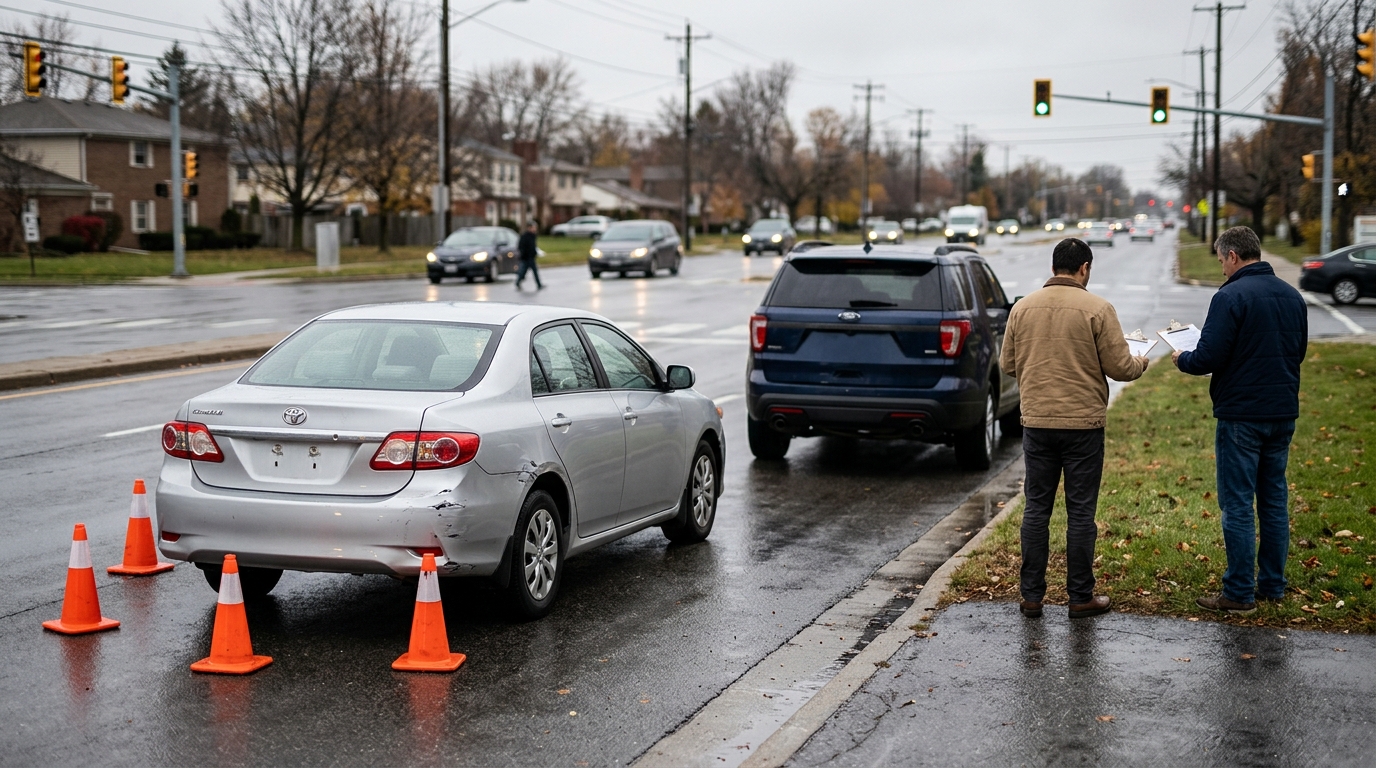
A not at fault accident ought to be the simple case — another driver caused the damage, so their carrier writes the check. Reality is messier, and the choices made in the first few days shape how fast the car gets repaired, whether a loaner is part of the deal, and how much money ends up in your hands. Below is a walkthrough of which insurer to bring the claim to, when a rental is something you're owed instead of a courtesy, and what a lowball settlement offer looks like when one lands.
In this article
Whose Insurance Should Handle a Not-at-Fault Crash
Almost everyone assumes the other driver's carrier takes care of everything after a crash they didn't cause. It generally does — yet that path is not automatically the quickest or the most profitable one.
A third-party claim goes straight at the at-fault driver's liability coverage, which is supposed to reimburse vehicle repairs, medical treatment, and other losses tied to the wreck. Nothing comes out of pocket as a deductible, and the claimant's own policy stays untouched. The downside is structural: that insurer owes the other driver no contractual duty whatsoever. Investigations can crawl, liability can be argued, and payment can sit unissued for weeks or even months.
Going through personal collision coverage, for drivers who carry it, puts a company that answers to them on the job. The deductible — commonly $500 or $1,000 — has to be fronted, but repairs get moving sooner because the carrier owes its own insured a duty of good faith. That insurer then chases the at-fault company through subrogation and returns the deductible whenever the money comes back.
Which route wins depends on a few things:
- State law. Under the no-fault systems in Florida, Michigan, New York, New Jersey, and Pennsylvania, personal injury protection (PIP) carried by the injured driver pays the medical bills first, no matter who caused the wreck.
- Liability disputes. When fault is being argued over, leaning on personal collision coverage sidesteps the whole fight about who did what.
- Damage severity. A $1,500 fender-bender against a $1,000 deductible is a case for billing the at-fault carrier instead.
- The at-fault driver's coverage. When that driver has no insurance or carries nothing but state-minimum limits, uninsured/underinsured motorist (UM/UIM) coverage becomes the thing that matters.
When a Rental Car Is Something You're Owed
Loss of use — being deprived of a car you can actually drive — counts as a recoverable damage everywhere in the country. File against the at-fault driver's insurer and that company has to supply a rental in a comparable class, or pay back the same daily rate, for as long as the car is in the shop or a total-loss settlement is still being worked out.
Watch the word comparable, though: it does not mean identical. Own a mid-size sedan and the match is usually an economy or compact car at $30–$50 per day. Anyone driving a full-size pickup or a work SUV should demand a same-class replacement in writing, because the Corolla-substituted-for-a-Silverado argument comes up constantly. Payment for the rental runs until the repair is finished or, on a totaled car, until a firm settlement offer lands — not until the check clears the bank.
Route the claim through personal collision instead and a rental only appears if rental reimbursement was purchased as an optional add-on. That endorsement runs $2–$5 per month and generally maxes out at $30–$50 per day against a per-claim ceiling of $900–$1,500. Here is where people get squeezed: when the repair outlasts what the cap buys — 20 days at $30 while a backordered part keeps the car in the bay for 45 — the leftover days are the driver's problem unless they can be shifted onto the at-fault carrier.
None of this covers a rental for convenience. A car that still drives fine while it waits for cosmetic work usually earns nothing from the insurer during the wait — only the days it is genuinely in the shop.
Spotting a Settlement Offer That Comes In Too Low
Opening offers on property damage and injury claims after a wreck someone else caused frequently come in 40–60% under the number an adjuster actually has authority to approve. That is by design rather than by accident: it is an opening bid, and the person making it fully expects an argument.
Signals that the figure on the table is light:
- The offer arrives within days of the accident. An honest valuation takes repair estimates, medical records, and time to assemble. Speed and generosity rarely travel together.
- The check comes with a pre-signed release. Signing the back of a first settlement check normally surrenders the right to reopen anything, injuries that show up weeks later included.
- The total-loss valuation ignores condition and options. Ask for the comparable-vehicle report. Carriers routinely benchmark against base-trim or high-mileage examples when the wrecked car had leather, low miles, or a fresh service history.
- No diminished value is included. Repair quality aside, a car wearing an accident on its history report resells for 10–25% less. Recovering that loss from the at-fault carrier is permitted in many states.
- Medical bills are averaged, not itemized. Some adjusters float a lump-sum medical allowance that quietly skips unpaid balances, physical therapy still to come, or referrals to specialists.
- The offer supposedly expires. What governs property damage and bodily injury claims is the state statute of limitations — usually 2–6 years — and not whatever deadline an adjuster invents for Friday afternoon.
Ready to compare car insurance rates?
See quotes from top insurers side by side. Free, about two minutes, no obligation.
Get My Quotes →How Diminished Value Works
Diminished value (DV) describes the hit a car's market price takes once an accident appears on its history report, even when every bit of damage was fixed correctly. Most states treat it as a legitimate loss, yet almost no insurer volunteers the money unless the owner brings it up.
It comes in three forms:
- Inherent diminished value — the stigma attached to a Carfax or AutoCheck hit. This is the version people claim most often.
- Repair-related diminished value — sloppy work that leaves visible flaws, uneven panel gaps, or paint that doesn't match.
- Immediate diminished value — the loss that exists the instant the crash happens, before a single repair is made.
On a newer car — under 5 years old with under 60,000 miles — inherent DV after a moderate-to-severe repair generally lands at 10–25% of pre-accident actual cash value. Take a $30,000 car with $8,000 worth of damage: $3,000–$5,000 in DV is a reasonable expectation. Older cars with big odometer readings tend to produce little or nothing worth chasing.
Pursuing DV from the at-fault driver's insurer means proving what the car was like beforehand with photos and service records, paying for an independent DV appraisal ($150–$400 from certified appraisers), and putting a demand in writing. Georgia, Kansas, and a number of other states have well-worn paths for recovering it; Michigan mostly closes the door on third-party DV.
What the Timeline Looks Like, Crash to Check
Nothing carries more weight than the first 72 hours. Calling police to the scene produces the document everyone in the claim will cite more than any other. Shoot photos of the damage, the plates, the insurance cards, and the setting itself — skid marks, signage, signals, anything blocking a driver's view. Take down contact details from every witness who offers them, because a name and number written on the shoulder beats hunting for a stranger two months down the road.
Tell your own insurer within 24–72 hours even if the plan is to bill nobody but the at-fault driver. Prompt notice is a condition of coverage under most policies, and it matters especially for a UM/UIM claim that surfaces later. Handing the at-fault carrier the basic facts — date, time, location, vehicles involved — is harmless. So is turning down a recorded statement until the questions are known, which is frequently the smarter move, because recorded answers get recycled as negotiating leverage against the person who gave them.
Once liability is settled, property damage files usually close in 15–30 days. Injury claims take much longer — commonly 60–180 days from crash to settlement — since carriers hold off until the injured person hits maximum medical improvement. Throw in contested fault, serious injuries, or a commercial vehicle and the file can run 12–24 months. The deadline for filing suit is set by state statute, from 2 years (California, Texas) out to 6 years (Maine, North Dakota), and it deserves a calendar entry, because negotiating with an adjuster does nothing to stop that clock.
Frequently Asked Questions
Will a crash that wasn't my fault push my rates up?
Most states bar carriers from surcharging a policyholder for a wreck they didn't cause, though the incident can still land on the driving record and the CLUE report. California, Oklahoma, and a few others put that prohibition directly in statute. Where no such law exists, most large carriers follow the same practice by choice — but quotes pulled from other companies while shopping may still price the accident in.
How many days does the rental car stay available?
The rental is paid for while the car is being fixed or, on a total loss, until the at-fault insurer puts a firm settlement offer on the table. In practice that runs 7–14 days for repairable damage and 5–10 days for a total loss, with parts backorders stretching things out. If the at-fault carrier stops paying before the shop finishes, a supplemental loss-of-use claim can go in once the vehicle is back on the road.
The other driver's insurer denied my claim — now what?
Ask for the denial in writing with the specific reason spelled out. When the sticking point is disputed liability, send in the police report, witness statements, and any photos or dashcam video that back up your version. Filing under personal collision coverage and letting that company handle subrogation is a solid fallback — your own insurer has money on the line, which gives it a reason to fight.
Am I required to give the at-fault carrier a recorded statement?
No. Nothing contractual ties you to the other driver's insurer, so no recorded statement is owed. Putting the basic facts in writing — date, time, location, vehicles — is enough to get the claim opened. Recorded statements are a standard tool for coaxing claimants into downplaying injuries or conceding partial fault, so declining, or waiting until the questions are on paper, protects the file.
What is pain and suffering worth on a claim like this?
It tracks how bad the injuries are and how long they last. The rough industry convention multiplies medical bills by 1.5 to 5 times for soft-tissue injuries, and by more when the damage is permanent. Against $8,000 in medical bills, a total settlement of $12,000–$40,000 is plausible — though no-fault thresholds in states such as Florida and New York limit when this category is recoverable at all.
Ready to compare car insurance rates?
See quotes from top insurers side by side. Free, about two minutes, no obligation.
Get My Quotes →