
Electric Vehicle Insurance Cost in 2026: What EV Owners Pay
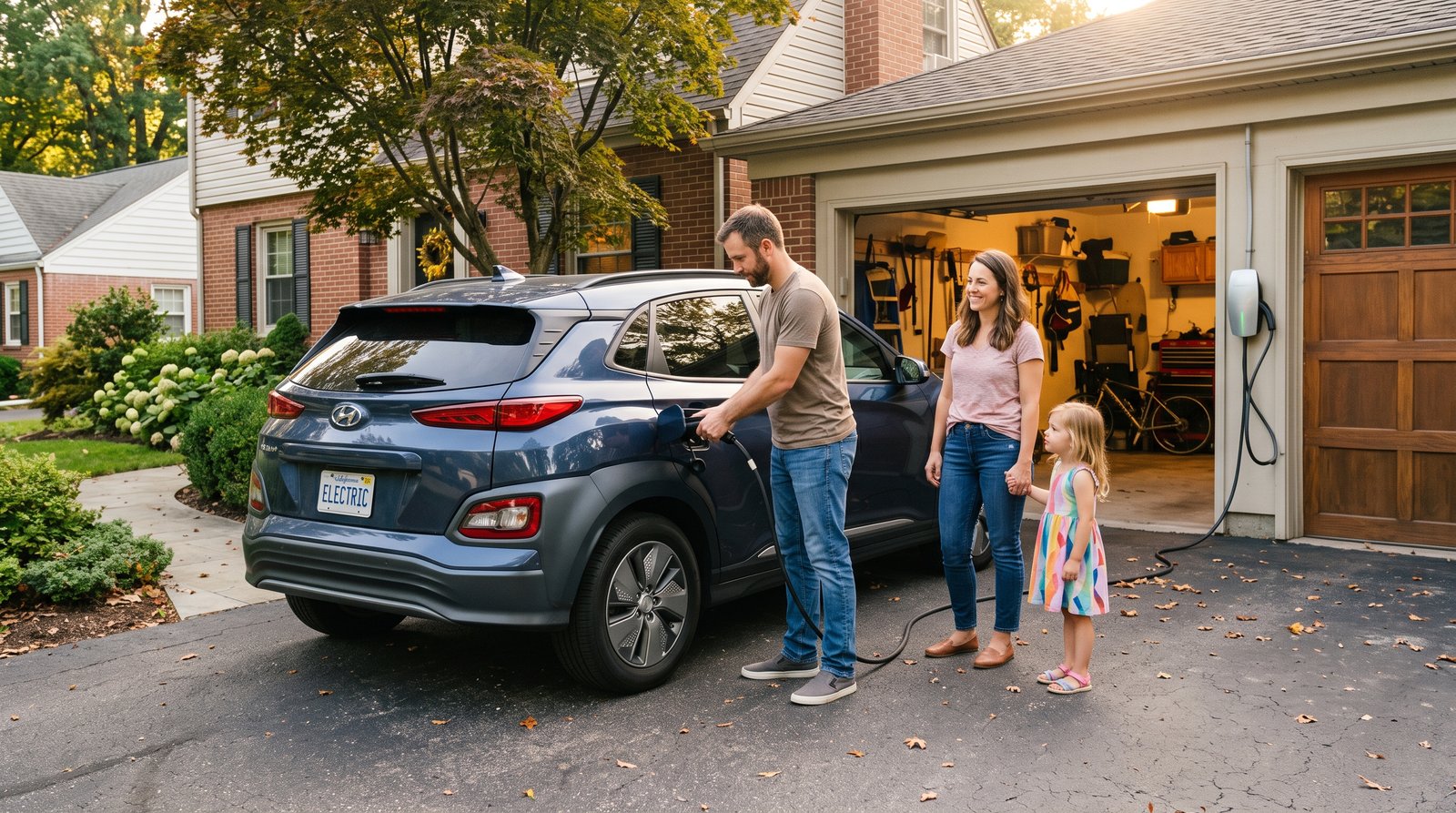
In 2026 the average electric vehicle insurance cost still lands somewhere around 15% to 30% above what a comparable gas car costs to cover, and that spread has refused to shrink even as EV adoption climbs. Expensive battery packs, technicians who command specialist labor rates, and a short list of certified body shops all push the number higher. Below are the figures Tesla, Rivian, Ford, and Chevy owners are seeing this year, plus an honest look at where the money goes.
In this article
- Why EVs still cost more to insure than gas cars
- What popular EV models average per year in 2026
- The four things pushing EV rates higher
- Carriers that have leaned into the EV market
- Why gap coverage matters more on an EV
- The charger coverage most owners never check
- Practical ways to cut an EV premium
- How the states stack up on EV coverage
Why EVs still cost more to insure than gas cars
Carriers price a policy around one question above all others: what will this vehicle cost to fix or replace after a claim? By that measure EVs remain at the expensive end of the market in 2026. The battery pack is the priciest single part in the car, and even a moderate hit to the rear or the side can compromise the pack badly enough that the insurer declares a total loss instead of buying a replacement.
Batteries are not the whole story. EVs cram sensors, cameras, and driver-assist hardware into bumpers, mirrors, and windshields at a density most combustion cars never reach. A parking-lot scrape that would be a $1,500 job on a similar sedan can run past $6,000 on an EV once radar modules, recalibration, and paint blending enter the estimate.
Labor is the third squeeze. Only some collision centers hold certification for high-voltage systems, so damaged cars get funneled toward a thin pool of approved shops. Add parts backlogs to that queue and rental days stack up, with total repair times routinely running weeks longer than the gas-car norm. Carriers build that exposure straight into the premium.
What popular EV models average per year in 2026
National averages paper over a lot of variation, yet they still give you a starting point. Using 2026 quote data for full-coverage policies on a clean 40-year-old driver, here is roughly where the best-known EVs sit:
- Tesla Model 3: about $2,400 to $2,800 annually
- Tesla Model Y: about $2,600 to $3,100 annually
- Rivian R1T: about $2,900 to $3,400 annually
- Ford F-150 Lightning: about $2,100 to $2,500 annually
- Ford Mustang Mach-E: about $2,200 to $2,700 annually
- Chevy Bolt: about $1,700 to $2,000 annually
Those bands are broad for good reason. A 25-year-old in Los Angeles insuring a Model Y can easily be quoted north of $4,500, while the identical car for a 55-year-old in Boise might come in at $1,900. Buying state-minimum coverage only slashes these figures, but it also exposes an owner to catastrophic out-of-pocket losses given what these vehicles cost to fix or replace.
The Chevy Bolt is still the affordability leader, and the Ford Lightning gains from being priced against conventional pickups. Rivian tops the list mainly on sticker price and a repair network for the brand that remains thin.
The four things pushing EV rates higher
Most of the distance between an electric vehicle insurance cost and its gas equivalent comes down to four things, and battery replacement leads them. Swapping a full pack costs $10,000 to $20,000 on mainstream models such as the Bolt or Mach-E and can climb beyond $30,000 on premium machines like Rivians and higher-trim Teslas. Any comprehensive claim where pack damage is suspected tends to end in a total loss, because carriers will not bet on internal cell degradation staying hidden for months.
Second comes specialized labor. Technicians certified on EVs bill at higher shop rates, and recalibrating driver-assist systems after nearly any collision tacks hours onto every job. Third is spotty parts availability. Tesla and Rivian both run closed parts networks, while Ford and GM have improved but still trail conventional gas-car supply chains.
Fourth, these cars are heavy. An F-150 Lightning outweighs the ICE version by roughly 1,600 pounds, and the extra mass means more energy in a crash and more damage inflicted on the other vehicle. Liability payouts on at-fault EV drivers have been climbing for that reason alone.
Ready to compare car insurance rates?
See quotes from top insurers side by side. Free, about two minutes, no obligation.
Get My Quotes →Carriers that have leaned into the EV market
Any major US insurer will write an EV policy in 2026, but a handful have chased the segment. Progressive and Allstate each sell EV-specific endorsements that put charging equipment and wall connectors on the auto policy instead of pushing them onto homeowners coverage. Liberty Mutual and Farmers have promoted dedicated EV packages including roadside assistance for battery dead-cell events, something standard roadside will not always tow for.
Then there is Tesla Insurance. Offered in roughly a dozen states in 2026, it prices a monthly premium off live telemetry from the car itself. Drivers who keep clean safety scores commonly report 20% to 30% savings against their previous carrier, while anyone who brakes hard or speeds often ends up paying more than they would elsewhere. The price of admission is letting the car report on how you drive.
Price aside, look for a company with a deep bench of EV-certified repair shops in your own state. A cheap policy from an insurer whose nearest approved shop is 100 miles away buys you a slower and more painful claim.
Why gap coverage matters more on an EV
EVs still lose value quicker than gas cars over the opening couple of years, and first-year drops of 10% to 20% are routine on mainstream models. That curve sets an insurance trap. Finance or lease the car, total it in year one or two, and what you still owe the lender will very likely exceed what the insurer pays out for actual cash value.
Gap coverage covers that shortfall. It is cheap, normally $20 to $60 a year tacked onto an auto policy, and after an early total loss on a $60,000 Lightning or R1T it can spare you $8,000 to $12,000. Some lenders roll gap into the loan itself, which is generally the priciest way to buy it. Attaching it to your own auto policy almost always costs less.
Federal EV tax credits and state incentives complicate the arithmetic. Take a $7,500 credit at purchase and your effective cost basis drops, yet the insurance payout still keys off market value. Which way the used-EV market moves during the year decides whether that gap widens or narrows, and nobody predicts it reliably.
The charger coverage most owners never check
Installing a Level 2 home charger, permits included, runs $1,500 to $4,000. Most owners assume the homeowners policy has it handled. Plenty do not, or cover it only in narrow circumstances. Some contracts treat a hardwired wall connector as a fixture and pick it up under dwelling coverage, while portable chargers, cords, and freestanding units are frequently excluded or protected against only a short list of perils.
The tidiest fix is an EV endorsement on the auto policy naming the charging equipment outright. Progressive, Allstate, and a number of regional carriers now write one. It usually costs a few dollars a month and answers for theft, vandalism, electrical surge, and accidental damage - every one of which is more common on garage-mounted and outdoor gear than owners tend to assume.
Renting complicates things further. The landlord often owns the charger while the tenant pays for the electricity, and neither side's policy necessarily covers damage to it. Pin down the coverage arrangement in writing before signing the lease.
Practical ways to cut an EV premium
Shopping the policy is the biggest lever by a wide margin. On the exact same EV, the gap between highest and lowest quote among major carriers routinely runs 40% to 60%. Pull at least three quotes each renewal cycle, and make one of them Tesla Insurance if you drive a Tesla somewhere it is offered.
- Pair it with a home or renters policy. Multi-policy credits on EVs generally land at 10% to 20%.
- Take a higher deductible. Going from $500 to $1,000 on comprehensive and collision usually saves $150 to $300 a year.
- Sign up for safe-driver telematics. Most large carriers discount 5% to 25% based on how you actually drive.
- Ask about anti-theft credits. GPS tracking and remote immobilization frequently qualify an EV.
- Revisit coverage as the car ages. Once market value slips under $12,000 to $15,000, plenty of owners drop collision altogether.
One more thing: paying the premium in full rather than monthly typically trims another 5% to 10%, since it spares the carrier the billing overhead.
How the states stack up on EV coverage
Where you live counts for as much as what you drive. Through 2026 the priciest states for EV coverage are still California, New Jersey, Michigan, Florida, and New York - each running roughly 30% to 40% over the national EV average. Michigan's no-fault framework keeps premiums inflated even after the recent reforms. California pairs steep labor and repair bills with roads that were already crowded.
At the other end, Ohio, Idaho, Iowa, Vermont, and Maine reliably rank among the cheapest places to buy a full-coverage EV policy. A Chevy Bolt owner in Boise might pay nearer to $1,300 a year, while that same driver profile in Newark could see a quote of $2,600 or higher. Crossing state lines is a genuine chance to reprice - just update the policy within 30 to 60 days of establishing residency so you stay compliant.
Whatever the state, your driving record, your credit-based insurance score where the law allows it, and your prior claims still carry the most weight in what you end up paying.
Frequently Asked Questions
What is the price difference between insuring a Tesla and a Honda Civic?
Across 2026, insuring a Tesla Model 3 typically costs somewhere between $700 and $1,100 more a year than a comparable Honda Civic, with the exact gap depending on state and driver profile. Battery replacement exposure, pricier parts, and the limited pool of Tesla-certified body shops able to handle collision work are what create the difference.
Is there a separate kind of policy just for EVs?
Not really. Standard auto policies cover most EVs, though many carriers now sell EV-specific endorsements or packages adding protection for charging gear, damaged cables, and battery-related roadside help. Tesla Insurance comes closest to a genuine EV-only product, pricing the policy from telemetry the car sends back.
Will my homeowners policy pay for a damaged EV charger?
Sometimes, but do not count on it. A hardwired wall-mounted charger may qualify as a fixture under dwelling coverage, while portable and freestanding units are often left out. The cleanest answer is to name the charging equipment on an EV endorsement attached to your auto policy - a few dollars a month, and the gap closes.
What makes EV repairs drag on for so long?
Two things. First, only a narrow set of body shops carry certification for high-voltage battery work, so vehicles pile up waiting for those bays. Second, EV parts pipelines are still catching up with demand, and recalibrating driver-assist sensors after nearly any repair adds hours to the job. Timelines measured in weeks are now standard on moderate-to-severe collisions.
Do I have to buy gap insurance on a new EV?
No law requires it, but it is close to essential on a financed or leased car. EVs lose 10% to 20% of their value in year one, so an early total loss can leave you owing thousands beyond what the insurer pays. For $20 to $60 a year on an auto policy, gap coverage is nearly always worth carrying through at least the first two years.
Ready to compare car insurance rates?
See quotes from top insurers side by side. Free, about two minutes, no obligation.
Get My Quotes →