
Car Insurance for Teen Drivers: A Parent's Cost Guide
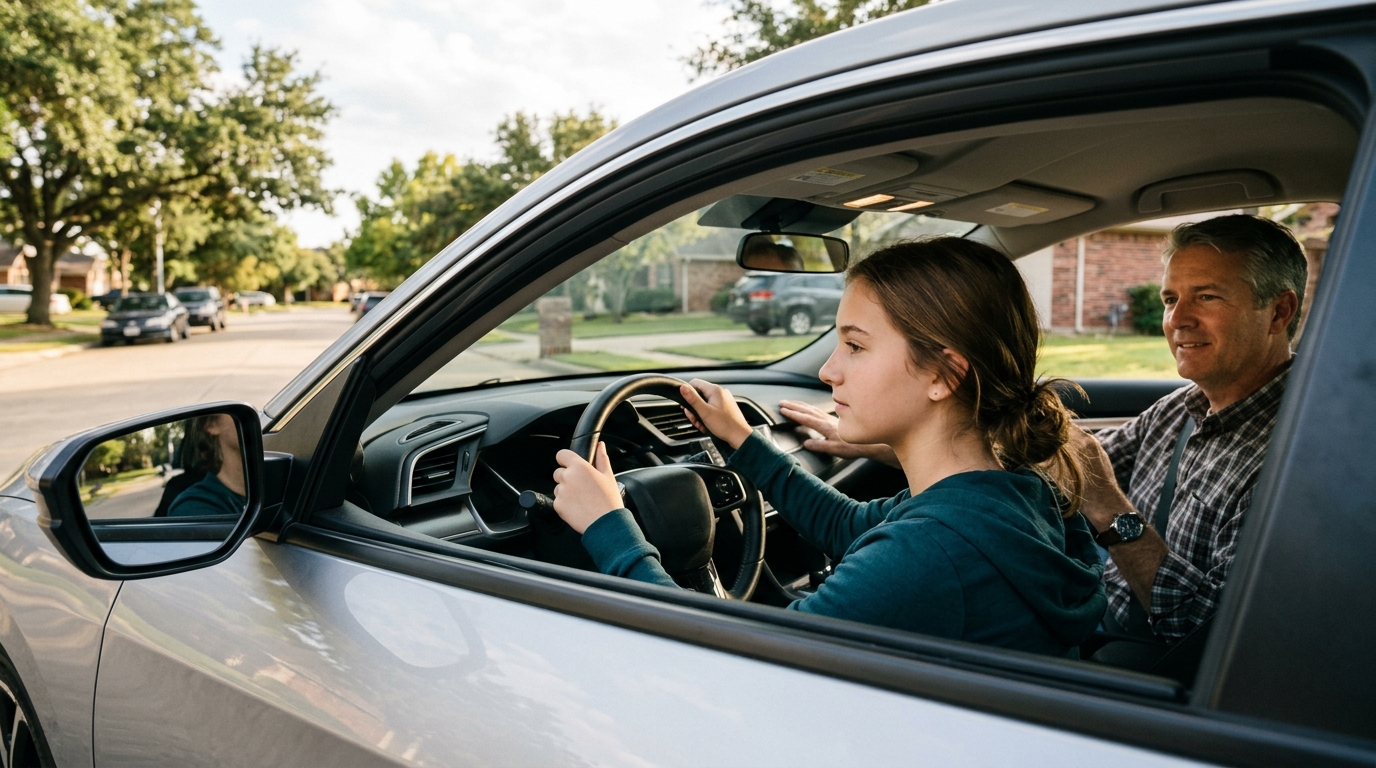
Few line items in a family budget jump the way car insurance for teen drivers does—putting a 16-year-old on the household policy usually lifts the six-month bill by 80% to 150%. What most parents miss is how much of that increase is negotiable: a handful of structural decisions about which car the teen is assigned to, whether they enroll in telematics, which discounts get stacked, and how coverage is tuned can shave roughly a third off the surcharge.
In this article
Why the Teen Surcharge Runs So High
Carriers set prices from claims data, and the record on drivers under 20 leaves little room for argument. For drivers between 16 and 19 the fatal crash rate runs roughly three times what it is for drivers 20 and up, and at-fault claim frequency sits well above average in nearly every category actuaries measure. The result is a premium that can more than double a household policy the moment the teen is added.
Teen boys draw the steepest surcharge, since both how often they crash and how badly run higher than for their female peers. That distance shrinks by 21 and is essentially gone by 25, which is why rates keep sliding through the mid-20s. State law shapes the surcharge as well: California, Hawaii, Massachusetts, Michigan, and Pennsylvania restrict or prohibit using gender in rating, so teen boys there will not face the premium spread they would in Texas or Florida.
How the teen is assigned to vehicles feeds into the cost too. By default most carriers attach the riskiest driver to the priciest car, so adding your teen can rerate the family SUV as though they drive it most of the time—even when the older sedan parked behind it is where they actually spend their miles.
The Real Price of Adding a Teen
In practice, the car insurance for teen drivers surcharge roughly doubles a six-month premium built for two adults, though the precise figure turns on your state, your own record, the vehicles involved, and the limits you carry. Typical increases fall in these ranges:
| Teen age | Typical premium increase | Notes |
|---|---|---|
| 16 (new license) | 100% to 150% | Steepest tier of all |
| 17 | 80% to 120% | Some relief after a clean first year |
| 18 | 60% to 100% | Larger drop with no tickets or claims |
| 19 | 40% to 80% | Nearing the young-adult tier |
| 20 | 25% to 55% | Still sliding toward standard pricing |
In dollars, a couple paying $1,600 a year to cover two cars often watches the total climb to $3,200 to $4,000 once a 16-year-old joins. The state spread is wide—Michigan, Louisiana, and Florida sit near the top of the national range, while Ohio, Maine, and Idaho are usually the cheapest places to insure a young driver.
The permit stage generally costs nothing; most carriers do not rate a permit holder. The bill jumps the day the full license is issued and the teen has to appear on the policy as a rated driver.
Discounts That Are Worth the Paperwork
Plenty of advertised teen discounts are not worth chasing. These are the ones that consistently save real money:
- Good student discount: 5% to 25% off the teen's share of the premium, normally requiring a B average or a top-20% class rank, with proof at every renewal.
- Driver's education or defensive driving: 5% to 10%, and states such as Georgia and Massachusetts often require the course anyway before a teen under 18 can license.
- Distant student discount: when a teen enrolls more than 100 miles from home and leaves the car behind, the surcharge can fall 20% to 40% while they stay covered as an occasional driver.
- Telematics or driver monitoring: Progressive Snapshot, State Farm Drive Safe & Save, and Allstate Drivewise can return 10% to 30% for teens who skip hard braking, late-night trips, and phone use at the wheel.
- Multi-policy bundling: moving home or renters coverage onto the same account usually saves 8% to 15% across the household bundle.
- Vehicle-specific discounts: anti-theft equipment, daytime running lights, and current safety features can shave another 2% to 10%.
Pass on telematics if the teen genuinely drives hard—the same programs that pay out for good habits can raise a premium once ugly data comes back.
Ready to compare car insurance rates?
See quotes from top insurers side by side. Free, about two minutes, no obligation.
Get My Quotes →The Case for a Standalone Teen Policy
In most households, folding the teen into the parents' policy beats a policy of their own, because the teen picks up the family's clean history, the multi-car discount, and the bundle. A freshly licensed 16-year-old writing their own policy usually pays $3,500 to $6,000 a year for basic coverage—more than the family-policy surcharge in nearly every scenario.
A few situations flip that math. Some states and carriers will not let a teen who owns and titles the car share the family policy. If the teen collects a serious moving violation or an at-fault crash, the surcharge on the family policy can outrun what a nonstandard carrier such as The General or Direct Auto would charge them alone. And when the parents carry high limits—$300,000/$500,000 with a $1 million umbrella—separating the teen shields those limits from a claim the teen causes.
Once a teen passes 21, owns the car, and lives at another address, an individual policy usually turns out cheaper on its own, so the switch happens naturally. Families weighing a split earlier than that should price both structures first—the hunch that a separate policy is tidier is usually wrong on cost.
A Sequence That Keeps the Increase Small
Order and structure matter here. For most families this sequence produces the smallest hit:
- Wait until license day to add them. Permit holders usually go unrated, so calling early only buys extra premium.
- Assign the teen to the least expensive car you own. Ask the agent to name the oldest, lowest-value vehicle as the teen's primary car—that step alone can cut the surcharge by 20% or more.
- Drop collision on anything worth under $4,000. When the teen drives a beater, spending $600 a year on collision for a $3,000 car rarely pays off across three years.
- Sign up for the carrier's telematics program immediately. A 10% to 15% safe-driving credit compounds against the largest surcharge on the policy.
- Re-verify good student paperwork every six months. Transcripts or report cards have to go back in at renewal, and the discount quietly falls off if nobody sends them.
- Reshop at 18 and again at 21. Pricing reshuffles at those age tiers, and the carrier that won at 16 may not still win three years later.
All of these moves are reversible, so there is no cost to stacking them.
Coverage Decisions That Carry More Weight Now
Because teens generate costlier claims, liability limits deserve a careful look before the license shows up. State minimums—commonly $25,000 per person and $50,000 per accident on bodily injury—rarely stretch across a serious multi-car wreck. Moving from the minimum to 100/300/100 generally runs $150 to $400 more a year and keeps a teen-caused injury claim from turning into a financial catastrophe.
Uninsured motorist protection gains value too. Roughly one in eight drivers in the US carries no insurance, and over a five-year stretch the odds a teen meets one are far from trivial. Independent agents routinely suggest matching UM limits to your liability limits.
An umbrella policy deserves real consideration once the teen is licensed. A $1 million umbrella typically costs $200 to $400 a year and layers over both the auto and the homeowners policy. For a family with assets on the line—retirement savings, home equity, a business—it is often the single best value among the coverage changes to make when a teen starts driving.
Deductibles deserve one last pass. A $500 deductible on collision and comprehensive is the norm, but going to $1,000 can cut 10% to 15% from those coverages—frequently a fair trade once the teen surcharge has pushed the premium up.
Frequently Asked Questions
Do I need to add my teen to the policy the moment they get a permit?
Usually not. In most states a permit holder driving with a supervising adult is already covered by the parents' existing policy without being listed. Some carriers still want to hear about the permit, so a quick call is worth making. Once the full license arrives, the teen has to be added or excluded in writing, or a claim can be denied.
Is adding a teen to my policy cheaper than buying them their own?
Adding them is nearly always cheaper, frequently by 30% to 50%, because the teen inherits the parents' clean record and the household discounts. A teen's own policy generally costs $3,500 to $6,000 a year for basic coverage. Going separate mostly makes sense when the teen owns the car outright, has serious violations that would spike the family rate, or the parents want to shield high liability limits from a teen-caused claim.
At what point does teen car insurance get cheaper?
Prices step down at 18, again at 21, and again at 25, when most carriers reclassify the driver into the standard adult tier. Three clean years on the record speed those steps up considerably. Across the span from 16 to 25, the total decrease usually lands between 60% and 75% when the record stays clean and the family sticks with one carrier.
Can I take my teen off the policy when they head to college?
When the school sits more than 100 miles away and the car stays home, most carriers apply a distant student discount instead of removing the driver—dropping the teen's premium 20% to 40%. Taking them off entirely would leave them uninsured on visits home, which rarely justifies the extra savings. Leaving them listed as an occasional driver is the usual answer.
Does a teen who only borrows my car once in a while need their own policy?
Any licensed teen living in your household has to be listed, occasional use included. Leaving a household driver off the policy hands the carrier grounds to deny a claim after a crash. If the teen truly lives elsewhere and only drives during visits, most policies extend coverage to permissive users, so no separate policy is needed.
Ready to compare car insurance rates?
See quotes from top insurers side by side. Free, about two minutes, no obligation.
Get My Quotes →