
Car Insurance for Seniors: What Changes After Age 65
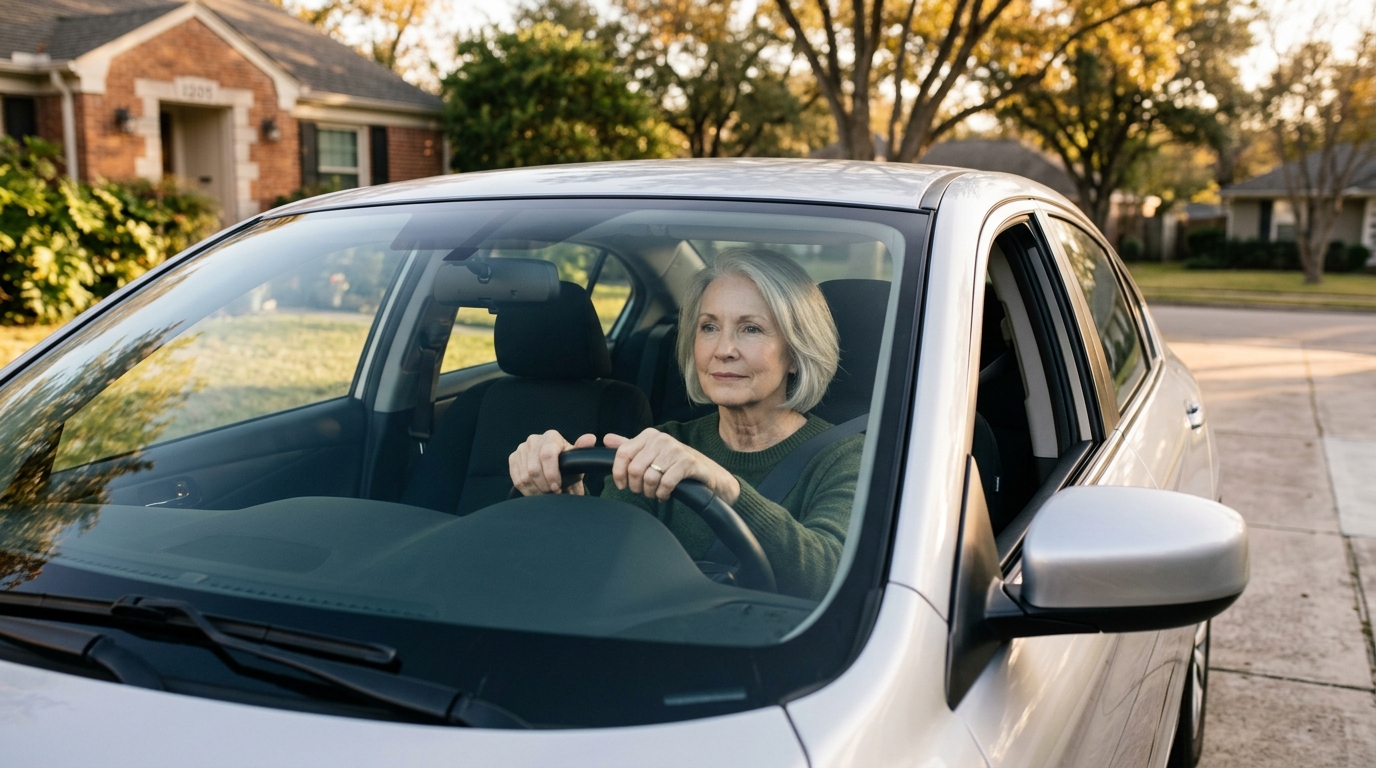
Car insurance for seniors traces an odd U shape: premiums slide down through middle age, bottom out in the late 50s, then turn upward again once a driver passes 65. The climb is not a penalty for growing older. It tracks genuine actuarial evidence that reaction time, night vision, and the severity of crash injuries all shift with age. The consolation is that no age group has more levers for pulling those rates back down, from state-mandated defensive driving credits to pay-per-mile coverage designed for retirees who cover 500 miles a month.
In this article
What pushes premiums up past 65
Carriers price on how likely a claim is and what it will cost to settle. Two things shift as drivers move into their late 60s and 70s. First, crashes per mile begin climbing, thanks to slower reflexes, medication side effects, and more collisions at intersections and during left turns. Second, older drivers who do crash tend to be hurt worse, so the medical side of the claim settles higher. Together those forces create what actuaries call a bathtub curve, where the cheapest premiums sit roughly between ages 55 and 65.
The climb is normally gradual. Someone paying $1,100 a year at 60 might see $1,150 at 68, $1,300 at 74, and $1,600 or more by 80. After 75 the steps get steeper, because that is where claim data shifts most sharply. Geography swings things just as hard. A 72-year-old in rural Iowa may pay $900 for the coverage that runs $2,400 in South Florida, where heavy traffic and expensive medical care lift premiums across every age band.
None of this flips on a birthday. Carriers reprice at renewal using your actual record, ZIP code, car, and mileage. A clean history and a garaged, low-value vehicle can hold a 78-year-old well below what a 45-year-old with two speeding tickets pays.
The mature driver course credit
The most dependable discount available to older drivers is the mature driver course credit. Most states make insurers offer it, and it usually knocks 5% to 15% off liability and collision premiums for three years. The classes run four to eight hours, cost $15 to $30, and can be finished entirely online through providers such as AARP Smart Driver, AAA RoadWise, or the National Safety Council.
A few details are worth knowing before you enroll:
- Rules differ by state. New York requires a 10% discount for three years. California obliges insurers to offer one without dictating the size. Florida and Texas have comparable mandates at different minimums.
- Carriers set their own age floor. Some open the discount at 50, others at 55, and a handful hold out until 60 or 65.
- Only a state-approved course counts. A generic online safety class will not qualify. Look for wording such as "mature driver improvement course" or "55 Alive."
- The credit expires. It runs out after three years, and a refresher course is needed to put it back.
For a driver paying $1,400 a year, 10% off saves $420 across that three-year window — a strong return on a $25 course.
Pay-per-mile and low-mileage options for retirees
Few life changes rearrange driving habits the way retirement does. The typical retiree covers 6,000 to 8,000 miles a year against 13,500 for the working-age population. Standard policies are priced around a roughly average-mileage customer, which leaves retirees quietly subsidizing households that drive far more.
Pay-per-mile coverage inverts that equation. You pay a low base charge plus a per-mile rate, usually 5 to 10 cents. A retiree driving 5,000 miles a year with Metromile, Allstate Milewise, or Nationwide SmartMiles frequently pays 30% to 50% less than a standard policy would cost. The trade-off is a small telematics plug-in or app that logs mileage and, in some cases, driving behavior.
Usage-based options such as Progressive Snapshot and State Farm Drive Safe & Save operate on a different principle. The policy keeps its traditional shape while the premium flexes with braking, acceleration, and the time of day you drive. Retirees who stick to daylight hours, dodge rush hour, and rarely brake hard usually earn the top discount, which tends to cap somewhere between 20% and 40%.
Ready to compare car insurance rates?
See quotes from top insurers side by side. Free, about two minutes, no obligation.
Get My Quotes →Coverage tweaks that move the bill
Shopping rates is only part of the job. The rest is sizing coverage to a financial picture that keeps changing. A handful of items are worth revisiting at every renewal:
- Rethink collision and comprehensive on an older car. Once the yearly cost of both passes 10% of the car's book value, the coverage is working against you. On a paid-off car worth under $5,000, dropping collision often frees up $300 to $600 a year.
- Take a bigger deductible. Going from $500 to $1,000 on collision usually shaves 15% to 25% off that piece of the premium. It only works if you have cash set aside for the larger out-of-pocket share.
- Do not shrink liability limits. This is the wrong place to economize. A retiree's house, savings, and Social Security income are all exposed if an at-fault crash turns into a lawsuit. Most agents advise at least $100,000 per person and $300,000 per accident, plus a $1 million umbrella once net worth clears $500,000.
- Bundle the home or renters policy. Multi-policy credits average 10% to 25% and are typically the biggest single discount on offer.
- Look hard at the car itself. A paid-off sedan costs 30% to 50% less to insure than a comparable SUV or pickup, so trading down at retirement often pays for itself inside two years.
Which companies tend to quote seniors well
No single company wins for every senior, but a few land near the top of independent rate comparisons for drivers past 65. The Hartford holds an exclusive AARP partnership and adds perks such as RecoverCare, which pays for household help after a crash, along with a lifetime renewal guarantee that blocks non-renewal over an at-fault accident. It often prices well for drivers 70 and older, though AARP membership is required.
For clean-record seniors in most states, Geico and USAA — the latter open to military families and their descendants — usually post the lowest raw rates. State Farm and Amica lead the claim satisfaction surveys, which counts for more as claims grow more frequent. The regional carriers Auto-Owners and Erie Insurance often beat the national brands inside their territories, so they are worth checking only if you live where they write.
The right habit is pulling three to five quotes each renewal cycle with identical limits and deductibles on every one. Rates move constantly as companies refile with state regulators, and a carrier that came in 20% high last year can easily be the bargain this year. Among seniors, the spread between the best and worst quote on identical coverage often reaches $600 to $1,200 a year.
Frequently Asked Questions
What age do senior car insurance rates start to climb?
Increases usually begin somewhere between 65 and 70, though the first one a driver really notices often lands around 70. By 75, most carriers apply a clearer age surcharge, and at 80 premiums frequently rival what a driver in their early 20s pays. Exactly when it starts depends on your carrier's actuarial tables and your state's rate filings.
Is the defensive driving discount for older drivers real?
Yes, and for drivers past 55 it ranks among the most dependable savings available. Most large carriers take 5% to 15% off liability and collision premiums when you finish an approved course, and the credit generally holds for three years before a retake is needed. New York, California, and New Jersey are among the states that require insurers to offer it.
Does pay-per-mile insurance pay off in retirement?
If you drive under roughly 8,000 miles a year, usage-based plans like Metromile, Allstate Milewise, or Nationwide SmartMiles typically beat a conventional policy. Retirees with no commute often finish the year at 4,000 to 6,000 miles, right in the sweet spot. If you still drive to Florida each winter or take a lot of road trips, run the numbers before switching.
Should an older driver drop collision on an aging car?
The usual rule of thumb: when the yearly collision premium plus the deductible tops 10% of the car's actual cash value, letting it go generally makes sense. Take a paid-off 2014 sedan worth $6,000 with a $500 deductible and a $600 collision premium — you are spending more every year than the coverage could ever pay back. Liability, uninsured motorist, and medical coverage should stay put either way.
Can an insurer cancel a policy just because the driver is old?
No state permits non-renewal on age alone, but carriers may decline to renew after at-fault accidents, license restrictions, or a failed medical driving evaluation. If a physician flags a cognitive concern to the DMV and the license is restricted, that can set off a policy review. Shopping the market ahead of renewal is the best protection.
Ready to compare car insurance rates?
See quotes from top insurers side by side. Free, about two minutes, no obligation.
Get My Quotes →