
Car Insurance for College Students: A Practical Guide
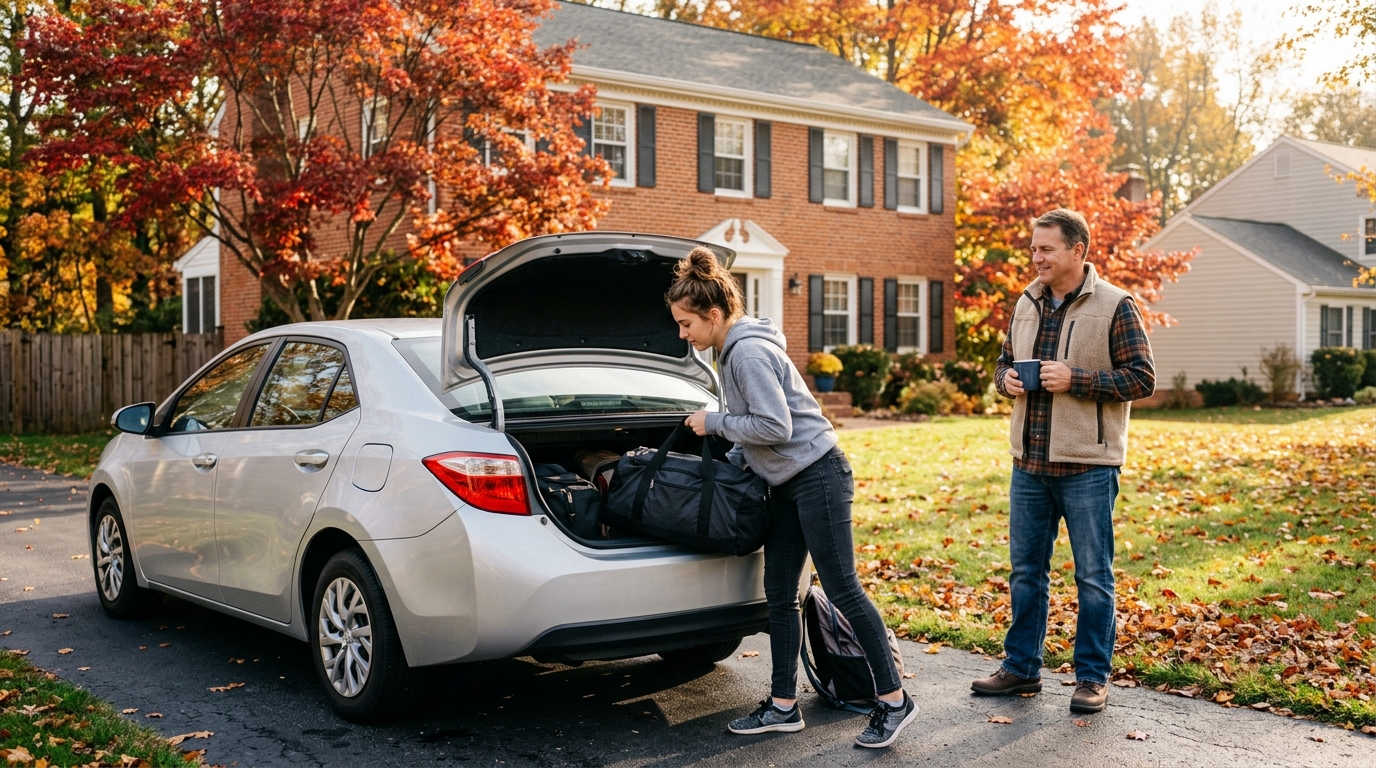
Car insurance for college students lands in an awkward spot — the student has a life of their own, yet is young enough that a policy in their own name runs two to four times what riding along on a parent's policy costs. One question usually settles the right setup: does the car go to campus, or stay parked in the family driveway? This guide walks through how the away-at-school discount works, when keeping a student on the family policy makes sense, and what quietly shifts about coverage when the car stays behind all semester.
In this article
How the Away-at-School Discount Actually Works
Most large insurers grant a discount once a full-time college student lives far enough away that they cannot use a family car regularly. State Farm, Geico, Allstate, Progressive, Nationwide, Farmers, and USAA each offer a version, generally labeled the student away at school or distant student discount. It does not pull the student off the policy; it reclassifies them from a primary driver to an occasional one.
Qualifying rules usually read something like this:
- The student is unmarried and under 25
- Enrollment is full-time
- They live at least 100 miles from the garaging address, or 150 at some carriers
- No vehicle from the household policy travels with them
- They still drive the covered cars when home on break
Savings normally fall in the 5-25% band on the slice of the premium tied to that young driver. Where the student adds $1,800 a year, that comes back as roughly $90-$450. On its own it is seldom a headline discount, but it layers on top of the good student credit and typically lasts through all four years of school.
When the Family Policy Is the Right Home
For the average undergrad, riding on a parent's policy costs far less than buying one. In most states a 20-year-old with a standalone policy pays $2,500-$4,500 a year for full coverage, while that same driver added to a parent's policy might raise it $800-$1,800. Insurers rate the household as a unit, so the parents' clean records, credit, homeowner status, and multiple vehicles all pull the risk profile downward.
Staying on the family policy also generally keeps the garaging address at the parents' house, which matters because location drives price so heavily: college towns inside dense metros such as Boston, Los Angeles, or Chicago can rate 20-40% above a suburban ZIP two states over. So long as the student's permanent legal residence is the parents' address and the car mostly sits there, the parents' rate governs.
One caution: never paper over a real move. A student who has relocated to another state, registered to vote there, works there year-round, and keeps the car there needs the policy to reflect that state. Insurers do investigate garaging fraud once a claim comes in, and misrepresentation can wipe out coverage on the loss itself.
What Shifts When the Car Never Leaves the Driveway
Once the carrier is told the student has gone to campus without a car, three things follow:
- The student is rerated as an occasional driver on the family vehicles, and their portion of the premium falls — more so when the away-at-school discount applies.
- Coverage on the family cars stays in force for winter break, spring break, and summer visits.
- The parents become the rated primary drivers on every vehicle in the household.
What families tend to miss is what happens on the occasional drive at school. Should the student borrow a roommate's car, permissive-use coverage from the family policy generally does not travel to a vehicle garaged somewhere else — the roommate's policy pays first, and it may not answer for the student's liability past its limit. A non-owner policy in the student's name, about $200-$500 a year, plugs that hole for students who often drive cars they do not own.
There is also the smaller matter of collision on the car the student would have been driving. If it is simply being used less, raising the deductible ($1,000-$2,000) can cut 15-30% from the collision portion without rethinking the coverage plan.
Ready to compare car insurance rates?
See quotes from top insurers side by side. Free, about two minutes, no obligation.
Get My Quotes →Discounts Worth Bringing Up
Car insurance for college students seldom hinges on one discount. The savings show up when every eligible one is stacked:
- Good student discount — typically 10-25% off. Carriers generally want a B average, a 3.0 GPA, or a top-20% class rank, documented with a report card, transcript, or dean's list letter.
- Distant or away-at-school discount — 5-25% when school is 100+ miles away and no car goes along.
- Driver training or defensive driving — many states make insurers offer 5-10% for state-approved courses, especially to drivers under 21.
- Multi-policy bundling — bundling the parents' home or renters coverage with auto usually trims 8-15% from the auto side.
- Low-mileage or usage-based programs — Progressive Snapshot, Allstate Drivewise, State Farm Drive Safe & Save, and Root pay for low annual mileage and careful driving. Students whose car sits home most of the year are natural fits.
- Alumni and affinity discounts — a few carriers, Liberty Mutual and GEICO included, discount for members of particular university alumni associations, and some apply while the student is still enrolled rather than only after graduation.
What the Coverage Really Costs in Practice
Actual quotes move around with state, driving history, and vehicle, but these bands capture the order of magnitude for a full-coverage policy involving a 19- to 21-year-old college student:
| Setup | Typical Yearly Premium Effect |
|---|---|
| On the parents' policy, car at home, away-at-school discount applied | $600-$1,200 added to the family policy |
| On the parents' policy, car taken to campus | $1,400-$2,400 added |
| Own policy, car garaged at school | $2,000-$4,500 total |
| Parents' policy with good student and distant student discounts, car at home | $400-$900 added |
The distance between car stays home and car goes to school is the most consequential variable of all — often bigger than what a strong GPA earns. Adding a student in a rural or suburban state (Iowa, Ohio, North Carolina) usually sits at the bottom of these bands, while the same student in Florida, Michigan, Louisiana, or New York frequently lands 40-70% higher thanks to no-fault statutes, urban density, or the cost of bodily-injury litigation.
Full coverage here means collision and comprehensive alongside liability limits of 100/300/100 or better. Dropping to the state minimum trims the premium but opens gaps that no family with real assets should accept.
The Moments That Force a Separate Policy
There is rarely any hurry to move a college student onto a standalone policy, though a few events force the change:
- The student buys a car titled and registered to them. Most carriers require the titled owner to be a named insured on the policy covering that vehicle.
- After graduation, a job in another state makes them a permanent resident there. Auto policies are written state by state, so a permanent move means a rewrite.
- The student gets married — spouses normally share one policy.
- The parents formally remove the student from the household, ending tax dependency or changing the address on file.
Timing the change for the end of a policy term avoids short-rate cancellation fees and lets the new carrier order a clean MVR. Waiting until 25 also knocks roughly 15-30% off by itself, so families who can legitimately keep a student on the policy into the mid-20s often do. When the switch finally comes, pulling three quotes the same day — one from the family's current carrier, one from a direct writer such as GEICO or Progressive, and one from a regional insurer — is the quickest way to see where a new graduate's rate really sits.
Frequently Asked Questions
Can my college student stay on my auto policy?
Yes, and it is almost always the least expensive route. As long as the student is still a household member and claims the parents' home as their permanent legal residence, most insurers keep them on the family policy — frequently right up to age 25 or 26. Even after graduation, students who move home or come back between jobs normally stay covered without any fuss.
What is the away-at-school discount actually worth?
Most carriers take 5-25% off the part of the premium attached to that young driver, which usually works out to $100-$500 a year depending on the state and the student's rating. The bigger savings come from pairing it with the good student discount and leaving the car at home for the semester instead of driving it to campus.
Does bringing the car to college raise the premium?
Usually, and often by a lot. Once the car is regularly garaged in a college town, the insurer rerates the policy to that ZIP code, which can move the premium either way depending on where the school sits. Urban college towns and no-fault states commonly push the increase 20-40% past the parents' suburban base rate, and the away-at-school discount stops applying.
What grades qualify for the good student discount?
The usual thresholds are a 3.0 GPA, a B average, or a top-20% class rank, proven with a report card, transcript, or a letter from the registrar. The credit is worth 10-25% off young-driver premiums, and it can be combined with the away-at-school discount when the car stays home.
Ready to compare car insurance rates?
See quotes from top insurers side by side. Free, about two minutes, no obligation.
Get My Quotes →