
Usage Based Insurance vs Traditional: Who Really Saves?
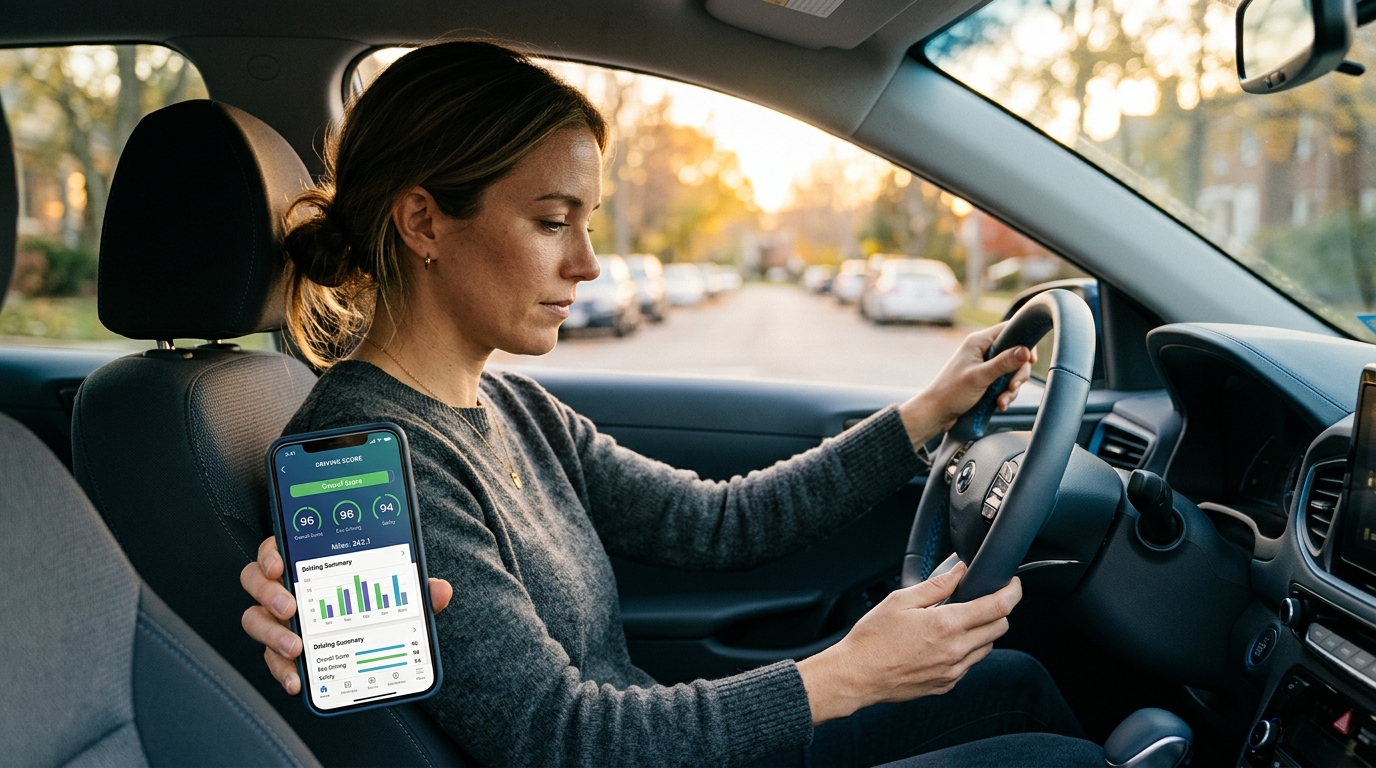
Weighing usage based insurance vs traditional coverage really turns on a single question: how far does your actual driving sit from what the insurer assumes? Snapshot from Progressive, Allstate Drivewise, State Farm Drive Safe & Save, and Nationwide SmartRide all dangle discounts as high as 30% or 40%, yet the fine print holds possible surcharges, monitoring windows, and privacy give-and-take. Below is a look at when telematics pays, when it bites back, and which drivers ought to leave the plug-in dongle alone.
In this article
What Telematics Programs Actually Measure
Usage-based insurance (UBI) relies on a smartphone app, a device plugged into the OBD-II port, or a factory-installed connected car system to observe driving behavior. Monitoring windows generally last 30 to 180 days, after which the carrier either locks a discount into the renewal or keeps adjusting the rate continuously. Four data points get the most attention: hard braking (roughly anything past 7 mph per second of deceleration), quick acceleration and cornering, the hour of the day (late-night trips score worse), and monthly mileage.
Phone handling gets flagged by some programs too — pick up a call or scroll while the car is rolling and the app registers it. Progressive advertises a typical first-term Snapshot discount somewhere around $100 to $150, while noting it can also tack on a surcharge as steep as 20% for high-risk scores in most states. State Farm's Drive Safe & Save and Metromile push further into genuine pay-per-mile pricing, tying premium straight to odometer readings.
How the Conventional Rating Model Prices You
Standard auto insurance builds rates from a fixed set of inputs: ZIP code, age, gender (in most states), credit score (in most states), the vehicle's make and model, claims history, the motor vehicle report, and an estimated annual mileage number carriers largely take at face value. Report 12,000 miles while really covering 4,000, and the conventional model quietly overcharges for 8,000 miles of exposure that never occurs. Closing precisely that gap is the whole point of telematics.
Conventional policies also stay blind to individual trips. Give two drivers matching credit, ZIPs, and vehicles and they pay alike, even if one runs DoorDash at 2 a.m. while the other drives to Publix on Sundays. Telematics compresses that difference toward real risk — excellent news for the Sunday driver, rough news for the late-night gig worker.
Drivers Who Gain the Most from Monitoring
In the usage based insurance vs traditional comparison, the obvious winners are drivers whose real behavior outperforms the assumptions inside their base rate. That crowd includes:
- Retirees and remote workers covering fewer than 8,000 miles a year
- Clean-record drivers whose commuting happens in daylight
- People with a second car, weekend vehicle, or classic that rarely leaves the garage
- Newly licensed drivers with safe habits to demonstrate (the discount can offset part of the under-25 surcharge)
- Households in low-traffic states such as Iowa, Vermont, or Idaho, where hard-braking events seldom happen
Garage-kept cars do especially well on pay-per-mile plans like Metromile and Nationwide SmartMiles. A vehicle that sits six days a week can fall from a $70 to $100 monthly premium down to $30 to $45. Behavior-based options such as SmartRide hand their largest discounts, approaching 40%, to drivers who avoid hard braking and stay off the road after dark.
Ready to compare car insurance rates?
See quotes from top insurers side by side. Free, about two minutes, no obligation.
Get My Quotes →When the Program Works Against You
The usage based insurance vs traditional call swings both directions: the very programs promising 30% off are able to push premiums up, and more states keep allowing surcharges for weak scores. Five kinds of drivers should hesitate:
- Night-shift and rideshare drivers — anything between midnight and 4 a.m. scores as high-risk no matter how skillfully it is driven
- Stop-and-go city commuters in Boston, Chicago, or San Francisco — dense traffic forces braking events an app cannot tell apart from aggression
- People driving older vehicles — a 2005 Camry with soft brakes logs harder deceleration than a 2024 EV using regenerative braking
- Anyone lending the car to a teenager or newly licensed spouse — every trip lands on the primary policyholder's score
- Regular long-haul road-trippers — heavy mileage erases the pay-per-mile edge and rural interstates can drag behavior scores down
Reports show Progressive Snapshot, Allstate Drivewise, and Root Insurance all raising rates after monitoring in states that permit it, with Snapshot surcharges hitting roughly 20% at the second-term renewal.
How the Big Programs Stack Up
Carriers reward different habits, and the headline discount rarely matches what a typical driver earns. Nationwide SmartRide and State Farm Drive Safe & Save are broadly viewed as the lowest-risk options, since neither one can raise a premium — the worst outcome is walking away without a discount.
| Program | Insurer | Max Discount | Can Raise Rate? | Monitoring Length |
|---|---|---|---|---|
| Snapshot | Progressive | 30% | Yes (up to ~20%) | 6 months |
| Drivewise | Allstate | 25-40% | Some states | Ongoing |
| Drive Safe & Save | State Farm | 30% | No | Ongoing |
| SmartRide | Nationwide | 40% | No | 3-6 months |
| RightTrack | Liberty Mutual | 30% | Some states | 90 days |
| SmartMiles | Nationwide | Pay-per-mile | N/A | Ongoing |
Real-world discounts usually settle near 10% to 15% rather than the advertised maximum. Read any 30% or 40% claim as a ceiling instead of an expectation.
The Privacy Side of the Bargain
Driving data stays with the insurer for as long as the policy runs, plus retention periods that can extend three to seven years past cancellation. Insurers are able to subpoena that data during accident claims, and in a handful of widely covered cases it has been used to deny coverage after fatal crashes. Marketers generally do not buy it, though it can travel to the insurer's affiliates, its reinsurers, and law enforcement holding a valid warrant.
Location practices differ program by program. Snapshot from Progressive intentionally skips GPS coordinates and logs only trip characteristics. Allstate Drivewise does capture location. Pay-per-mile plans including Metromile and SmartMiles require location data to confirm miles and enforce their pricing. Anyone driving somewhere they would rather keep private — a second job, a therapist's office, a divorce attorney — ought to read the privacy policy before installing an app or plugging in a dongle.
Trying It Out Without Getting Locked In
Every major carrier allows a trial run at telematics without a permanent commitment. A careful approach dodges most of the surcharge exposure:
- Start during a renewal cycle, so the policy can be dropped or replaced when the term ends
- Choose the smartphone app over the dongle — uninstalling it is simple and no mechanic is needed to pull hardware out
- Track the running score in the app through the first fortnight and 20 trips
- When the score keeps landing at Good or above, ride out the monitoring window and bank the discount
- When it drifts toward Fair or Poor, get out before a surcharge attaches at second-term renewal
Progressive, State Farm, and Nationwide each let drivers back out during the monitoring window with base coverage intact. Root Insurance is the outlier, treating a three-week telematics test as the underwriting decision itself — score poorly and no policy gets offered at any price, with no conventional rate to fall back on.
Frequently Asked Questions
What discount do telematics programs typically deliver?
Typical savings land at 10% to 15%, far below the 30% to 40% ceilings carriers put in their ads. Nationwide SmartRide and State Farm Drive Safe & Save usually deliver the strongest real-world results because a poor score costs nothing. Progressive Snapshot averages $100 to $150 off in the first term, but it can also apply a surcharge for high-risk driving.
Could a telematics program push my rate higher?
In most states, it could. Progressive Snapshot, Allstate Drivewise, Liberty Mutual RightTrack, and Root are all able to surcharge weak driving scores at renewal, with Snapshot's capped near 20% in most states. The two big programs that never increase rates are Nationwide SmartRide and State Farm Drive Safe & Save, making them the safest to sample.
Will a usage-based program record my location?
That hinges on the program. Progressive Snapshot deliberately steers clear of GPS and captures only trip traits such as braking, acceleration, and time of day. Allstate Drivewise, Metromile, and Nationwide SmartMiles all log location, either because per-mile pricing needs odometer verification or because geography feeds the score. Each program spells this out in the privacy terms presented before you enroll.
Should a driver with a rough record try telematics?
Generally no. Frequent hard braking, late-night commutes, or constant stop-and-go city driving tend to produce poor scores no matter the skill behind the wheel, and where surcharges are legal the program can lift premiums 15% to 20%. Someone already carrying an at-fault accident or two is usually better served by a conventional policy from a budget carrier such as GEICO or Erie than by chasing a telematics discount.
How long will the insurer monitor my driving?
Windows range from 90 days with Liberty Mutual RightTrack to 180 days with Progressive Snapshot. Nationwide SmartRide generally spans three to six months, while State Farm Drive Safe & Save keeps watching for as long as the policy stays active. Per-mile plans such as Metromile and SmartMiles monitor for the entire life of the policy, since their pricing rests on live mileage data.
Ready to compare car insurance rates?
See quotes from top insurers side by side. Free, about two minutes, no obligation.
Get My Quotes →